I am a planetary scientist currently working as a postdoctoral CNES fellow at the Laboratory of Plasma Physics in Paris. My work focuses on airless bodies, the evolution of their surface under space weathering, and their associated signatures.
CNES Postdoctral Fellow at LPP (Laboratoire de Physique des Plasmas)
Co-I on BepiColombo/MSA
Personal Details
Family name, First name: Verkercke, Sébastien
ORCID: https://orcid.org/0000-0002-1966-6553
ADS Publication list: https://ui.adsabs.harvard.edu/user/libraries/pV_LkKfVR7-BKUze-mfYKQ
Education and key qualifications :
26/09/2025 PhD in Astronomy and Astrophysics – Laboratoire Atmosphères, Observations Spatiales (LATMOS), Université Paris Saclay, France
2022 Master in Space Science, Summa cum laude, Université de Liège, Belgique
2020 Master in Physics, Université Libre de Bruxelles, Belgique
Current positions :
2025 – 2027 Postdoctoral research fellow at Centre National D’Études Spatiales, Laboratoire de Physique des Plasmas (LPP), École Polytechnique, France
2025 Scientific Collaborator at Laboratoire Atmosphères, Observations Spatiales (LATMOS), Sorbonne Université, France
Previous positions:
02-05/2026 Postdoctoral international exchange fellowship – Department of Astrophysics, American Museum of Natural History (AMNH) of New York, Richard Gilder Graduate School, United States of America
2022 – 2025 Teaching assistant at Physics Department, Université Versailles Saint-Quentin-en-Yvelines – Paris Saclay, France
2024 – 2026 Team Leader for an International Space Science Institute (ISSI) team
Team: Multi-scale Understanding of Surface-Exosphere Connections (MUSEC)
Recent Key Achievements
2026 – Postdoctoral international exchange fellowship at the Richard Gilder Graduate School at the American Museum of Natural History in New York regarding the “ Effect of volatile surface coverage on the dust accretion in protoplanetary disks”.
2026 – Invited speaker at Columbia University – Astronomy & Astrophysics Department to present my research on the « Multi-scale Study of Surface-Exosphere Links at Mercury with Numerical Models and Spacecraft Data » – https://www.astro.columbia.edu/events/seminar-sebastien-verkercke
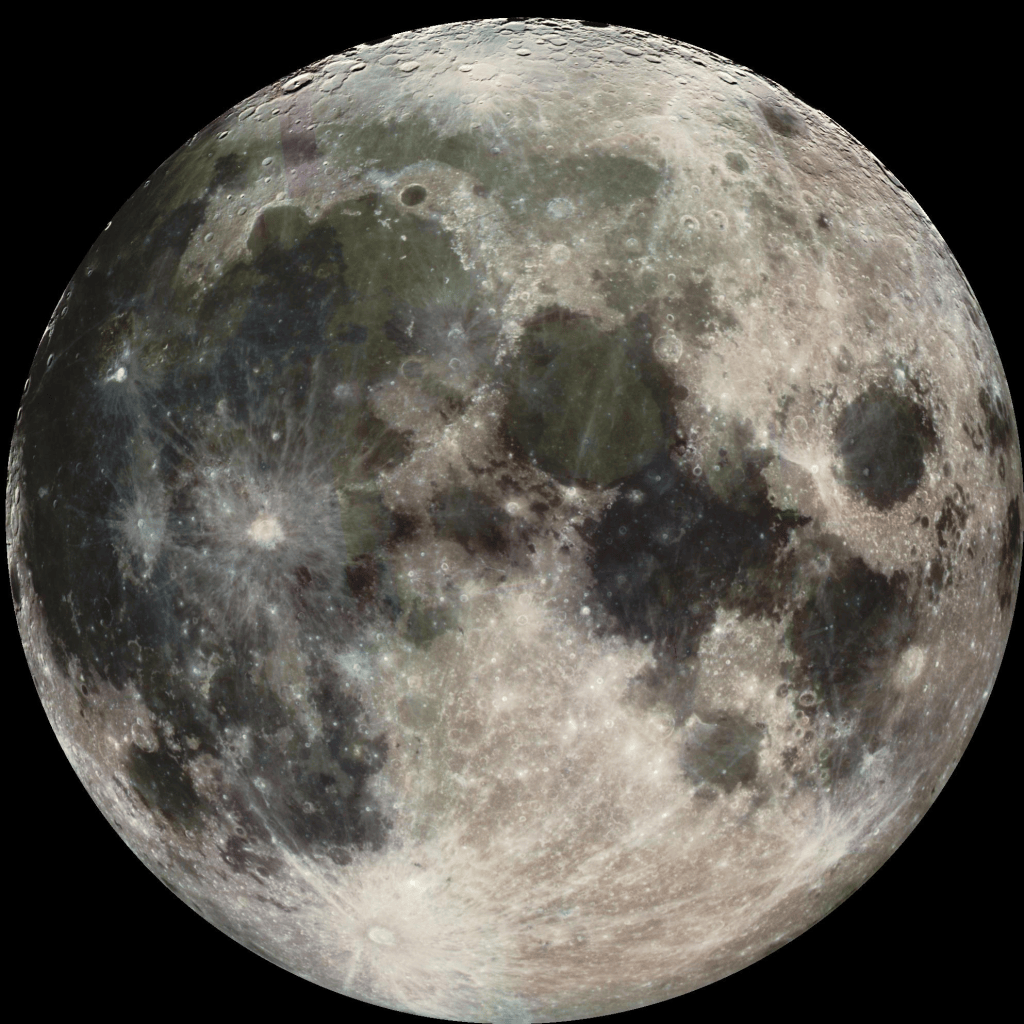
2026 – Invited speaker at the European Space Agency ESTEC “AstroLEAP – Lunar Environment Analysis Package Science Workshop” to present my work on lunar science, with a focus on my study on the thermal origin to the asymmetry of the permanent dust cloud at the Moon.
2026 – Co-organizer of the “Impacts in the Solar System and across spatial scales” workshop as ESA/ESAC. The workshop aimed to advance our understanding of impact processes across the Solar System, with a particular focus on airless bodies such as the Moon, Mercury, Martian moons, and icy moons. – https://www.cosmos.esa.int/web/impacts-solar-system-across-spatial-scales/home
My Research
In the Solar System…
Airless bodies, such as asteroids, comets, or the Moon, are the most common objects in our Solar System. Although they are all different, their surfaces interact with solar radiation, energetic particles, dust, and meteoroid impacts. These alteration processes are shared by all airless bodies and contribute directly to the evolution of these objects. The evolution of an airless body can thus be tracked through the different signatures caused by these processes. The signatures associated with the alteration of an airless body can include its surface structure, composition, thermal properties, or even the atoms ejected from its surface.
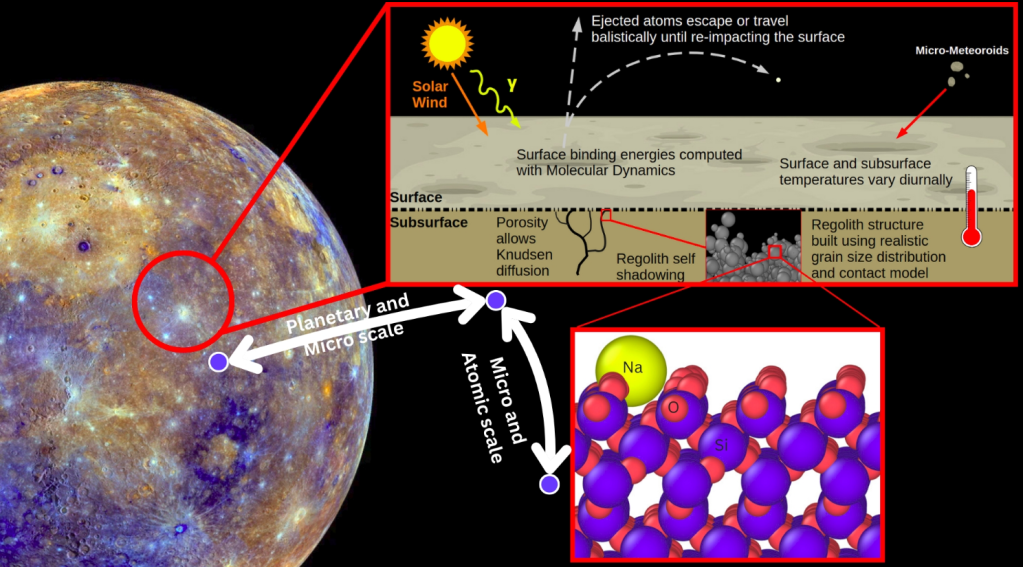
The current challenge in the field is that these signatures are often intertwined, as all the alteration processes act simultaneously, but with varying intensities. This results in surface heterogeneity when these processes act anisotropically on the same body. Moreover, the alteration processes, mainly driven by radiation, particles, and dust, affect the surface at the molecular or microscopic scales, while our observations only capture larger-scale planetary signatures, where all of this information is entangled.
My approach is to study these airless bodies using a multiscale framework, from the atom to the planet, to uncover the underlying physical processes responsible for the observables detected by telescopes and spacecraft.
Atoms & grains
To fully resolve surface interactions with radiation, plasma, neutral gas, or dust, a complete understanding of atomic interactions and regolith packing is needed. My research focuses on constraining the molecular interactions occurring at the surface of airless bodies using state-of-the-art molecular dynamics simulations. In parallel, I study regolith formation using granular simulations that resolve the contact physics between grains, as well as impact models describing the overturning of the regolith.
Moons and planets
With the fundamental physics constrained by multiphysics models at smaller scales, planetary observations can be reproduced using thermal and exosphere models. This approach has been applied to different bodies and has reproduced some observables that could not be explained with previous, simpler approaches, such as the sodium cold-pole enhancement measured by the MESSENGER spacecraft.
…and Beyond!
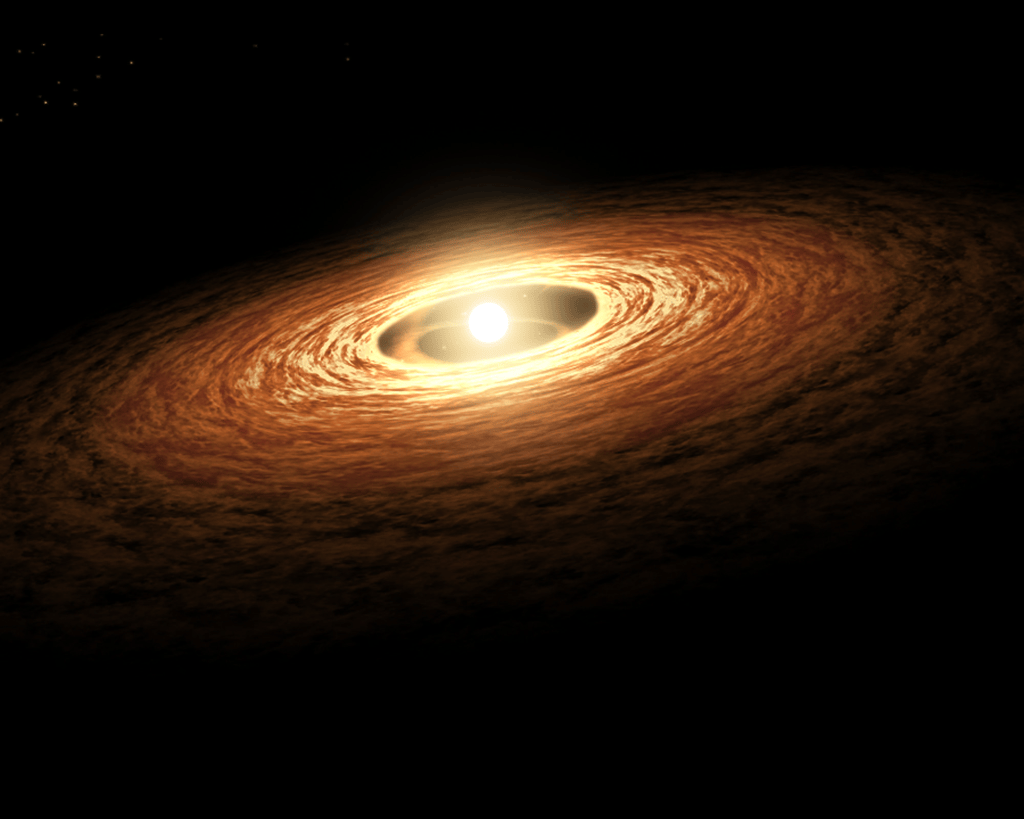
How dust grains stick together is key to understanding how planets and moons form. Tiny silicate and graphite grains collide in the disks around young stars, and the results can either be sticking, bouncing, or breaking. These determine whether larger bodies can grow. Past experiments in the laboratory in space and on the Moon suggest that grains stick at much lower speeds than many models assume, but these experiments may not represent true space conditions because of surface contamination. My project uses computer simulations to study perfectly clean or contaminated grain surfaces at the atomic scale to compute more realistic values for the stickiness of dust in space.
During my Annette Kade Postdoctoral Fellowship at the Department of Astrophysics of the American Museum of Natural History, I was able to study the dust collisions using numerical tools such as Molecular Dynamics and granular models. As water is abundant in protoplanetary disks and in Earth’s atmosphere, studying the effect of water adsorption on dust grains was the obvious starting point of my study, as it would have implications on the dust properties both in experiments performed on Earth and in models of disks around stars. Our study allowed to identified the water coverage as one of the main parameter influencing the stickiness of the grains, and to show that highly hydrated dust grains can be a hundred time less sticky than dry grains which can be found under space conditions. By studying other parameters of the dust clusters, such as the porosity, the size of the grains and of the aggregates, or the angle of the collisions, I was able to infer an empirical fitting function that would describe the fragmentation threshold of a cluster as a function of the dust physical and chemical characteristics. This function is particularly relevant for larger scale models which cannot afford to solve full 3D simulations for each cluster collision, and where a simple formula based on the micro-physics of the dust can help to improve the prediction of the models.